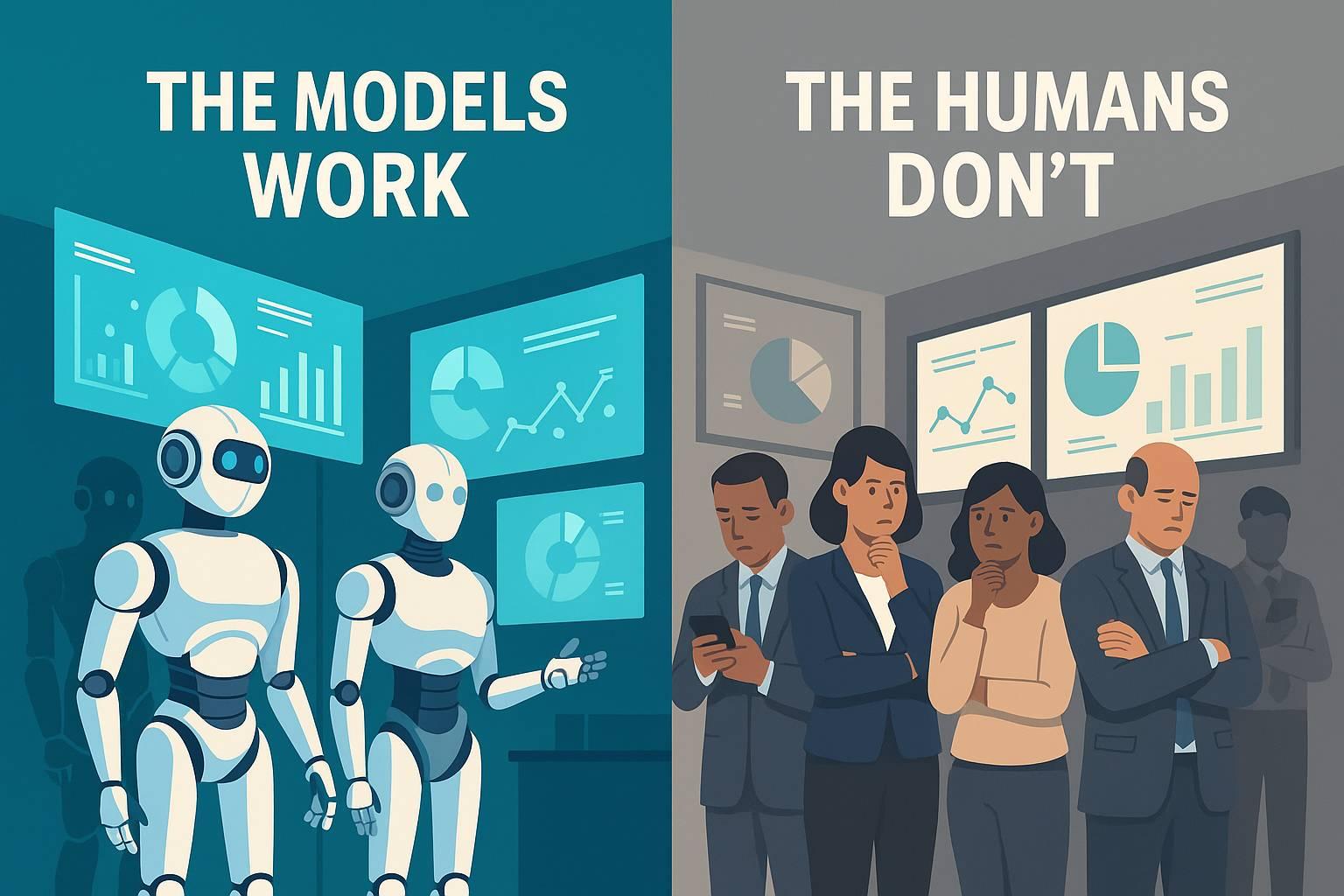
When Accenture spends $865M to replace workers, Salesforce cuts 4,000 jobs overnight, and IBM eliminates 8,000 HR positions, we’re witnessing the end of the “reskill everyone” fantasy
The Confession That Changed Everything
Three words from Fortune 500 CEOs in September 2025 shattered the comfortable lie we’ve been telling ourselves about AI and work:
“We can’t retrain.”
Not “won’t.” Not “shouldn’t.” Can’t.
Julie Sweet at Accenture said it. Marc Benioff at Salesforce proved it. Arvind Krishna at IBM executed it. When the companies that literally teach others about transformation admit they can’t transform their own people fast enough, we’ve crossed a line we can’t uncross.
Sweet chose her words carefully when speaking to Fortune magazine about her company’s $865 million restructuring:
“We’re trying to, in a very compressed talent timeline where we don’t have a viable path for skilling, sort of exiting people so we can get more of the skills in we need.”
Let that sink in.
Accenture – the $90 billion consulting giant with 770,000 employees – the very company that Fortune 500 CEOs hire to teach them about AI transformation, just admitted something extraordinary: Some workers simply cannot be retrained fast enough for the AI age.
Sweet wasn’t talking about factory workers or entry-level staff. She was talking about consultants. Strategic advisors. The people who literally advise others on transformation.
“We’re reversing five decades of how we’re working,” she told Fortune. This wasn’t corporate speak. This was an admission that everything we know about work is obsolete.
The Numbers That Should Terrify You
Three days before Accenture’s confession, OpenAI quietly released something called GDPval – a benchmark that tested AI against human professionals across 44 occupations. Not on academic tests or coding challenges, but on real work: legal briefs, engineering blueprints, investment analyses, customer support conversations.
The results painted a picture no one wants to see:
- 47.6% of economically valuable tasks can now be done by AI at human expert level
- 2x improvement in just 15 months (from 13.7% in spring 2024)
- <2 years until AI outperforms humans on most knowledge work at current rates
But the corporate response tells an even starker story:
The September 2025 Massacre
- Accenture: $865 million to “optimize” workforce, expecting $1 billion in savings
- Salesforce: 4,000 customer support roles eliminated for AI agents
- IBM: 8,000 HR employees replaced with a single AI chatbot
- Microsoft: 30% of all code now written by AI
- Shopify: CEO Tobi Lütke’s new hiring rule: “Before you ask for new head count, show me that AI cannot do the job”
The pattern is undeniable: It’s cheaper to fire and rehire than to retrain.
What Industry Leaders Know That You Don’t
Here’s what makes this story so revealing: These companies have every advantage. Unlimited training budgets. The world’s best talent. Direct access to every AI company on Earth. They literally wrote the playbooks on digital transformation.
And yet, they’re all reaching the same conclusion.
The endgame is already visible. Some companies are openly building “zero-FTE departments” – entire functions run by AI agents with humans merely watching from the sidelines. They’re not hiding it anymore. They’re counting AI agents on their org charts like actual employees. One pioneering firm lists “324 human FTEs, 89 AI agents” in their customer service division. By next year, those numbers will flip.
Julie Sweet’s revelation came as she described advising CEOs who complain they aren’t seeing returns from AI. “It’s because they’re trying to apply it to how they operate today,” she said. But changing how you operate – truly changing – means acknowledging that some people won’t make the transition.
Marc Benioff was even more blunt at Salesforce’s Dreamforce conference: “Agentforce is not just an evolution; it’s a revolution in how we think about customer service.” Translation: The humans aren’t coming back.
At IBM, Krishna has been transparent about his vision: “AI will change every job. The question isn’t whether your job will be affected, but how quickly you can adapt to working alongside AI.”
The dirty secret? Even these leaders know adaptation has limits.
The Human Cost of Exponential Change
I spoke with professionals across three major consulting firms who asked to remain anonymous. Their stories paint a consistent picture:
A senior consultant at a Big Four firm: “Six months ago, I was teaching clients about AI strategy. Today, an AI agent can do 70% of what I do, better and faster. I’m not being replaced – yet – but I’m basically becoming a prompt engineer for AI systems that do the actual analysis.”
She paused. “The weird part? I’m more productive than ever. I’m delivering what used to take two weeks in two days. But I need fewer team members. So who stays and who goes?”
A Salesforce enterprise architect: “We spent three years training on their platforms. Now Agentforce does what took me months to configure in minutes. They’re not firing architects yet, but new projects? They need one of us for every five they used to.”
An HR director at a Fortune 500: “We had a five-year reskilling roadmap. AI made it obsolete in six months. Now we’re just hiring people who already know AI and… managing the exits for those who don’t.”
This is the paradox every company is navigating: AI makes individual workers incredibly productive, but you need far fewer of them.
The Three Futures Fighting for Control
Future 1: The Augmentation Story (What Companies Want You to Believe)
This is the comfortable narrative being pushed hard by tech giants:
- Microsoft’s Satya Nadella: “AI will amplify human ingenuity”
- Google’s Sundar Pichai: “AI is a tool to enhance human capabilities”
- OpenAI’s economists: “AI is a complement to workers”
Even Microsoft admits it: 50% of executives plan to maintain headcount but use AI as “digital labor.” Translation: Same number of humans, triple the output. Until they realize they don’t need the humans at all.
Kyndryl published a framework positioning AI agents as “digital coworkers.” McKinsey released reports about “human-AI collaboration.” Everyone’s singing the same soothing song.
But then why is Accenture firing people it can’t retrain? Why did Salesforce eliminate 4,000 jobs? Why is IBM’s workforce shrinking while its AI capabilities grow?
Future 2: The Replacement Reality (What’s Actually Happening)
Let’s be honest about what we’re seeing:
- Entry-level hiring in tech, consulting, and finance has essentially frozen
- Junior analyst roles at investment banks are disappearing
- Customer service departments are shrinking by 50-80%
- Code review and QA positions are being eliminated
- Content creation teams are being “optimized” across media companies
The Stanford Future of Work project found something telling: Workers want much more human agency in AI interactions than companies are planning to give them. The gap between what workers want and what companies are building is vast and growing.
Future 3: The Transformation Truth (Where We’re Headed)
Julie Sweet might have revealed the real future when she said Accenture is “reversing five decades of how we’re working.”
This isn’t about humans vs. AI or even humans with AI. It’s about fundamentally reimagining what work means. The winners won’t be those who retrain fastest – even Accenture can’t do that. The winners will be those who redesign work itself around human-AI collaboration.
But here’s the catch: That redesign requires far fewer humans than we have today.
Industries Next in Line for “Optimization”
Based on insider conversations and public announcements, here’s the timeline:
Next 6 Months:
- Accounting: Big Four firms preparing major “restructuring” (20-30% workforce)
- Legal: Contract review and discovery roles already disappearing
- Marketing: Content creation and campaign management being automated
Next 12 Months:
- Financial Advisory: Robo-advisors expanding to complex planning
- Healthcare Administration: Prior authorization, billing, scheduling
- Education: Standardized curriculum delivery and grading
Next 18 Months:
- Middle Management: Coordination and reporting roles
- Engineering: Routine design and testing work
- Research: Literature reviews and data analysis
What This Means for You
If companies with unlimited resources – Accenture, IBM, Salesforce – can’t retrain their workforce fast enough, what chance does your company have? What chance do you have?
The answer isn’t in learning to code or becoming an AI expert. Everyone’s doing that. The answer is in understanding what makes you irreplaceable.
Sweet gave us a clue: “Most CEOs would say their organization is too siloed,” she said. The barriers to AI aren’t technical – they’re organizational, cultural, human.
The people who will survive this transition: 1. Those who can navigate organizational complexity 2. Those who can build trust and manage relationships 3. Those who can make decisions with incomplete information 4. Those who can innovate beyond pattern recognition 5. Those who can lead through ambiguity
But for everyone else? Sweet already told us what happens: “Exiting people in a compressed timeline.”
The Uncomfortable Truth About Timing
The comfort we take in “gradual transition” is a luxury we don’t have. Consider the acceleration:
- 2023: AI was a chatbot that could write emails
- 2024: AI became a coder, analyst, and designer
- 2025: AI is now replacing entire departments
McKinsey’s Jorge Amar – who advises Fortune 500s on this very transition – says we’re 18-24 months from full-scale deployment. Not adoption. Not experimentation. Full scale.
At this pace, by 2026, the question won’t be “Will AI affect my job?” but “Do I still have one?”
Marc Benioff didn’t give his 4,000 customer service reps time to reskill. IBM didn’t offer its 8,000 HR employees a transition period. When companies move, they move fast.
The Clock Is Ticking
OpenAI’s GDPval shows AI performance doubling every 15 months. Major corporations are spending billions on “optimization” because they know they can’t keep up with training. The market is rewarding companies that choose AI over retraining – Accenture’s stock rose 5% after announcing its restructuring.
This isn’t a future threat. This is happening now, in real-time, at the companies that should be most prepared for it.
The revolution isn’t coming. It’s here. And it’s moving faster than even the experts can handle.
Julie Sweet said they need “courage” to make these changes. But courage isn’t what workers need now.
We need clarity about what’s happening. We need honesty about who will survive this transition. And we need to act before we become another line item in someone’s “business optimization program.”
The companies have made their choice. They’re choosing AI.
The question is: What’s yours?
Action Items for Survival
If You’re an Employee:
- Document your non-automatable value – What problems do you solve that aren’t in any manual?
- Build your exit strategy now – Don’t wait for the “optimization” announcement
- Focus on judgment roles – Move toward positions requiring human discretion
- Create multiple income streams – Your job security is an illusion
- Network aggressively – Relationships are harder to automate than tasks
If You’re a Manager:
- Be honest with your team – False hope helps no one
- Identify who can transition – Not everyone can, and that’s okay
- Redesign roles now – Don’t wait for HR’s “transformation initiative”
- Advocate for your irreplaceable people – Fight for those who add unique value
- Prepare for difficult conversations – They’re coming whether you’re ready or not
If You’re a Business Owner:
- Accept the reality – Resistance is more expensive than adaptation
- Move fast – Your competitors already are
- Invest in AI infrastructure – It’s not optional anymore
- Redesign, don’t just reduce – Reimagine how work gets done
- Be transparent – Your people know what’s coming anyway
The Final Word
When I started researching this piece, I wanted to find hope. I wanted to discover that Accenture was an outlier, that the reskilling promise was real, that we had more time.
Instead, I found CEO after CEO admitting the same truth: The pace of change has outrun our ability to adapt.
This isn’t pessimism. It’s mathematics. When AI capability doubles every 15 months but human learning stays constant, the outcome is inevitable.
The companies spending billions on “optimization” aren’t evil. They’re rational actors responding to exponential change. The tragedy isn’t that they’re choosing AI over workers. The tragedy is that they don’t have a choice.
Neither do you.
The reskilling myth is dead. The only question left is: What will you do now that you know?
Shameless plug:
Do you know someone who can benefit by learning the fundamentals of Artificial Intelligence (AI) and Machine Learning (ML)? You are in luck!
I have created a fundamental course on AI/ML where I explain this complex topic is the most simply way - some of my students calls it “oversimplifying”!
Click on this link and gift them the course - and yes, they do not need technical background. I mean it - else they get their money back! Guarantee!