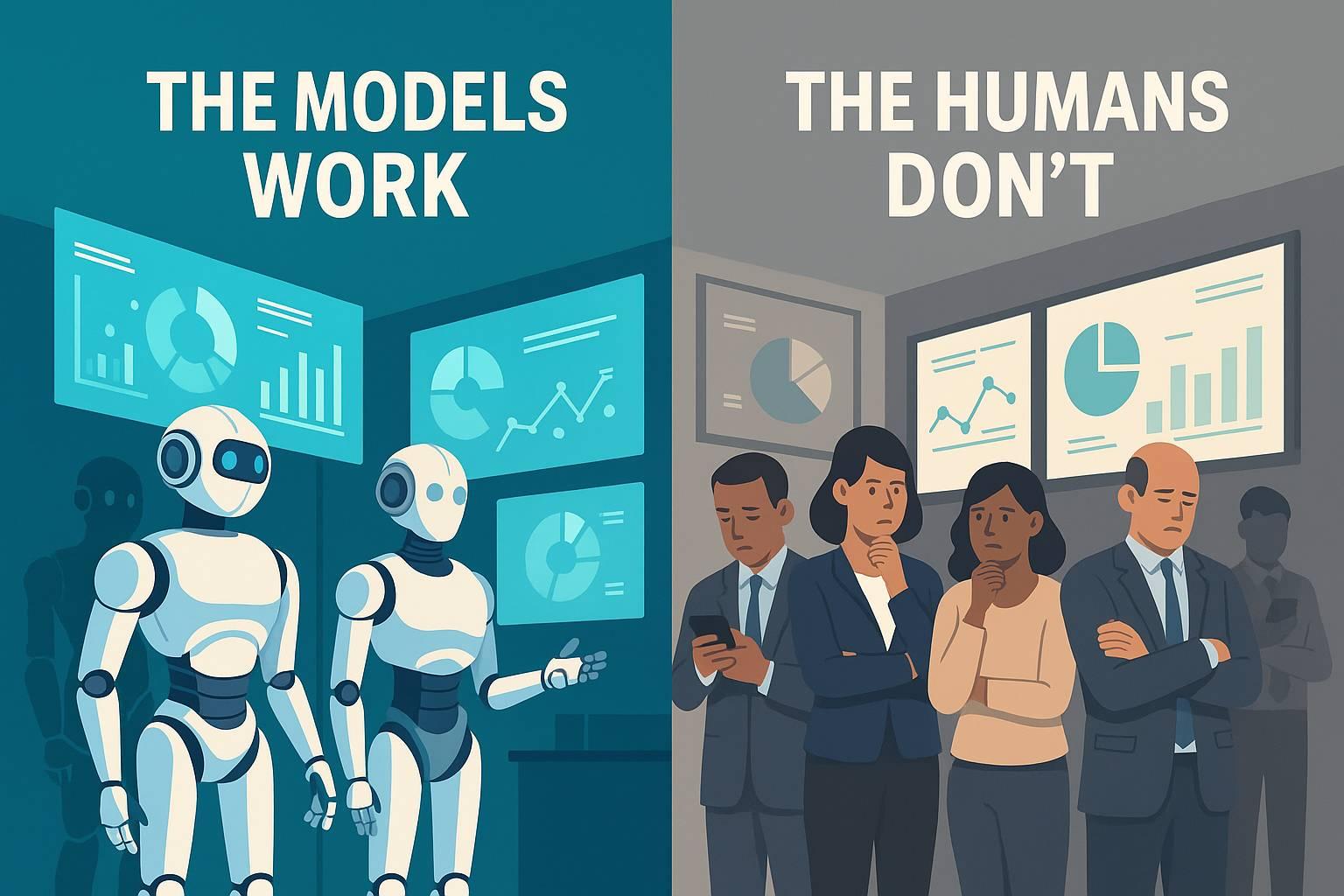
On one side, I'm building AI products that automate exactly what middle managers do—coordination, status tracking, project management.
On the other side, I'm training thousands of professionals on how to work with AI.
And here's what I'm seeing that nobody else is talking about:
The companies eliminating middle managers are making a catastrophic mistake. But the middle managers clinging to their old job description are making an even bigger one.
The Massacre Is Already Here
Let me show you what happened in 2025 alone:
- Amazon: 14,000 corporate jobs cut—CEO Andy Jassy said extra management layers "slowed decisions"
- Google: Eliminated 35% of managers overseeing small teams
- Starbucks: Cut roles "focused primarily on coordinating work"
- Meta: Zuckerberg's "managers managing managers" purge
- Intel: 15,000 positions in their "Great Flattening"
The phrase "reducing management layers" came up 98 times on S&P 500 earnings calls in 2025—double the frequency of 2022.
The data is brutal:
- Middle managers: 29% of all layoffs (up from 20% pre-2020)
- Job postings for managers: Down 40% since 2022
- Managers aged 35-44: Layoffs up 400% from 2022 to 2024
- Span of control: Doubled from 3 to 6 direct reports since 2019
This isn't a trend. It's a massacre.
The Conversation Nobody Expected
Two months ago, I was consulting with a Fortune 500 company deploying AI. The CTO pulled me aside.
"We just cut 40% of our middle management layer," he said. "Saved $15M annually. Wall Street loved it."
Pause.
"But our projects are falling apart. Nobody knows who's making decisions. Engineers talk directly to VPs who don't understand technical details. We're actually slower now."
He leaned in: "We eliminated the coordinators. But we forgot we still need someone to coordinate."
That's when it clicked.
Why AI Came for Middle Management First
Here's the truth from someone building these AI tools:
AI is phenomenal at what traditional middle managers do:
- Status reports? AI auto-generates from project tools
- Tracking progress? AI monitors 24/7
- Routing decisions? AI assigns based on context
- Performance reviews? 41% of managers use AI to draft them
- Cross-team coordination? AI workflows handle it automatically
The math: One manager handled 3-5 people before. Now companies run teams with one manager per 50+ people.
Peter Cohan, management professor at Babson College: "The job of middle managers is to translate executive visions into specific tasks."
AI does exactly that. Cheaper, faster, 24/7.
The Skill That Got You Here Won't Get You There
Here's the paradox from training 25,000+ professionals:
The skills that made you successful in 2020 are what make you redundant in 2025.
Two managers from my training programs (names changed):
"Sarah" - 15 years experience. Amazing at tracking projects, writing updates, coordinating teams.
Laid off March 2025.
"James" - 12 years experience. Did the same work as Sarah.
Just promoted to Director.
What's the difference?
What James Did That Sarah Didn't
When AI tools rolled out in 2023, Sarah doubled down on coordination—getting better at status reports, optimizing tracking systems.
All things AI now does better.
James asked a different question: "If AI can do what I do, what should I be doing instead?"
His answer: "The things AI can't do."
Old James:
- 60% gathering status updates
- 20% writing reports
- 15% coordination meetings
- 5% making decisions
New James:
- 5% reviewing AI reports
- 70% making judgment calls on priorities, conflicts, trade-offs
- 20% building trust across teams
- 5% training AI on company context
Same person. Completely different job.
Result: James now manages 4x as many people—and does it better.
Coordinator → Orchestrator
From both building AI and training professionals, here's the transformation:
Old Middle Manager = COORDINATOR
- Gathered information
- Passed messages up/down
- Tracked deadlines
- Wrote reports
New Middle Manager = ORCHESTRATOR
- Makes judgment calls AI can't make
- Resolves human-AI conflicts
- Translates ambiguous vision into strategy
- Builds psychological safety
- Trains AI on company context
Think of it: AI is the world's best orchestra player—perfect pitch, never tires, 24/7.
But orchestras still need conductors.
The Three Skills That Matter Now
1. Judgment in Ambiguity
Real scenario from my consulting: Product team must decide—ship now with bugs, or delay and miss market window?
- AI: "Ship now" (competitor analysis)
- Engineers: "Delay" (quality standards)
- Sales: "Ship now" (customer commitments)
Manager's job? Make the call considering team morale, technical debt, customer relationships, company reputation.
AI can't do this.
2. AI System Training
Two companies, same AI tool:
- Company A: +40% productivity
- Company B: +5% productivity
Difference? Company A has managers who train AI on company-specific context, processes, priorities.
New skill: You manage the AI that manages workflows.
3. Trust in Hybrid Teams
When your team is humans + AI agents, someone must:
- Know when to override AI recommendations
- Spot when AI is hallucinating
- Maintain human connection in automated workflows
Quintessentially human work.
Your Action Plan
Phase 1: Audit Your Time (This Week)
Categorize every task:
- Red: AI can do (status updates, scheduling, reports)
- Yellow: AI assists, needs human judgment
- Green: Only humans can do (conflict resolution, strategy, relationships)
If >50% is Red, you're in danger.
Phase 2: Redesign (Next 2 Weeks)
For every Red task:
- Can AI do entirely? → Automate
- Can AI draft, you review? → Delegate + spot-check
Shift freed time to Green tasks.
Example:
- Stop: Writing status reports manually
- Start: "Decision hours" where team brings judgment calls
Phase 3: Become the Bridge
- Learn which AI tools work for your workflows
- Train AI on your company's context
- Be "the person who makes AI work for us"
The Economic Reality
The data shows what's replacing middle management:
- High-paid strategists ($250K+): Growing
- Low-paid executors ($50-60K): Growing
- Middle management ($120-180K): Disappearing
Fed Chair Jerome Powell: The economy is "bifurcated"—AI benefits flow to the top while middle-income workers get squeezed.
The career ladder is broken:
Before: Entry → Senior → Lead → Manager → Director → VP
Now: Entry → ??? → VP (maybe)
The Three Types Right Now
From hundreds of companies I've worked with:
Type 1: Dinosaurs (~40%)
Still doing coordination AI does better.
Outlook: Extinct within 18 months.
Type 2: Transitioners (~35%)
Using AI but thinking like coordinators.
Outlook: Depends on evolution speed.
Type 3: Orchestrators (~25%)
Evolved. Focus on judgment, strategy, relationships.
Outlook: Secure. Getting promoted.
Which one are you?
What Companies Are Learning (Too Late)
Here's the secret from my consulting work:
Companies that eliminated managers are quietly bringing them back—with different titles and job descriptions.
Why? That Fortune 500 CTO's realization: You can automate coordination, but not judgment, trust, and context.
The winners aren't the ones with fewest managers. They're the ones whose managers evolved.
The Uncomfortable Truth
If your job fits in a process document, AI replaces you.
If your job requires:
- Reading the room
- Knowing when to push vs. back off
- Understanding unspoken context
- Building trust through dysfunction
- Making calls with incomplete information
You're more valuable than ever.
The problem? Most middle managers spent a decade optimizing for the wrong category.
Your Move
Option 1: Keep coordinating. Hope AI doesn't notice.
Outcome: Gone within 18 months.
Option 2: Evolve into an orchestrator making AI 10x more effective.
Outcome: More valuable than ever.
Companies needing coordinators are eliminating them.
Companies needing orchestrators are desperately searching.
Same person. Different skills. Different future.
The Final Reality
That Fortune 500 CTO? They didn't rehire the 40% they cut.
Instead, they took the remaining 60% through an intensive program—evolving coordinators into orchestrators.
I helped design it.
The results? Faster project delivery than before the cuts. Higher employee satisfaction. Evolved managers getting promoted.
The middle manager job isn't dying. It's transforming.
Companies that figure this out first will destroy their competition.
The ones that don't? They'll keep cutting until they realize they removed the connective tissue that made everything work.
P.S. At AI Guru, we're building tools to help orchestrators manage hybrid human-AI teams.
But tools alone aren't enough. The orchestrators winning right now understand how to architect agentic AI systems—not just use AI tools.
That's why I'm relaunching my Agentic AI for Leaders course in 10 days on Maven. It's specifically designed for leaders transitioning from coordination to orchestration—teaching you how to design AI systems that reason, decide, and act autonomously.
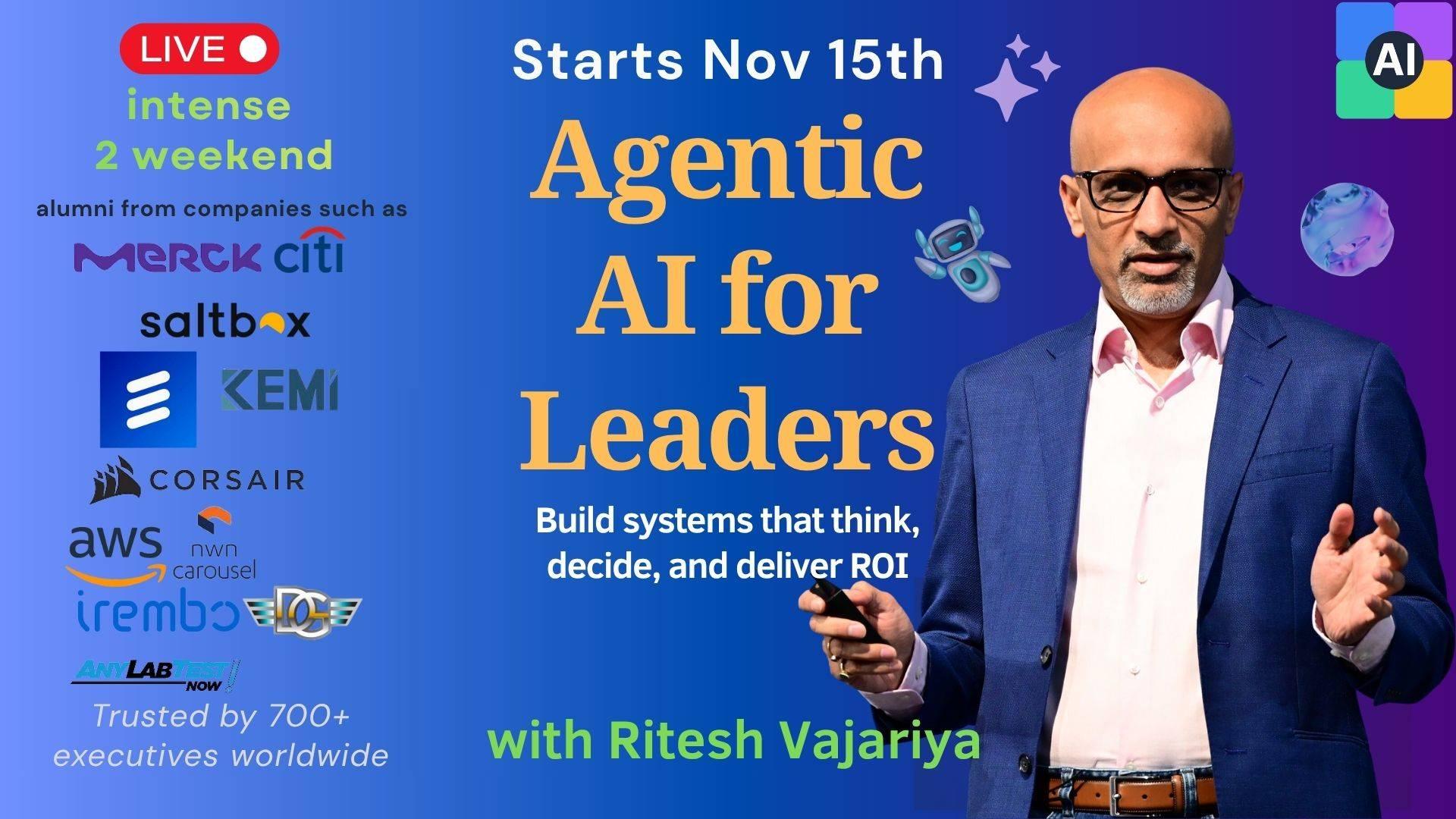
700+ global leaders have already gone through it. If you're ready to evolve from coordinator to orchestrator, this is your fastest path
Still spending days coordinating what AI does better? No tool saves you.
Ready to architect the systems that make you indispensable? The window's open. Not for long.
P.P.S. Seeing this shift in your organization? Trying to evolve from coordinator to orchestrator? Hit reply—I read every response.
Stay ahead of the curve. The future isn't waiting.
Shameless plug:
Do you know someone who can benefit by learning the fundamentals of Artificial Intelligence (AI) and Machine Learning (ML)? You are in luck!
I have created a fundamental course on AI/ML where I explain this complex topic is the most simply way - some of my students calls it “oversimplifying”!
Click on this link and gift them the course - and yes, they do not need technical background. I mean it - else they get their money back! Guarantee!