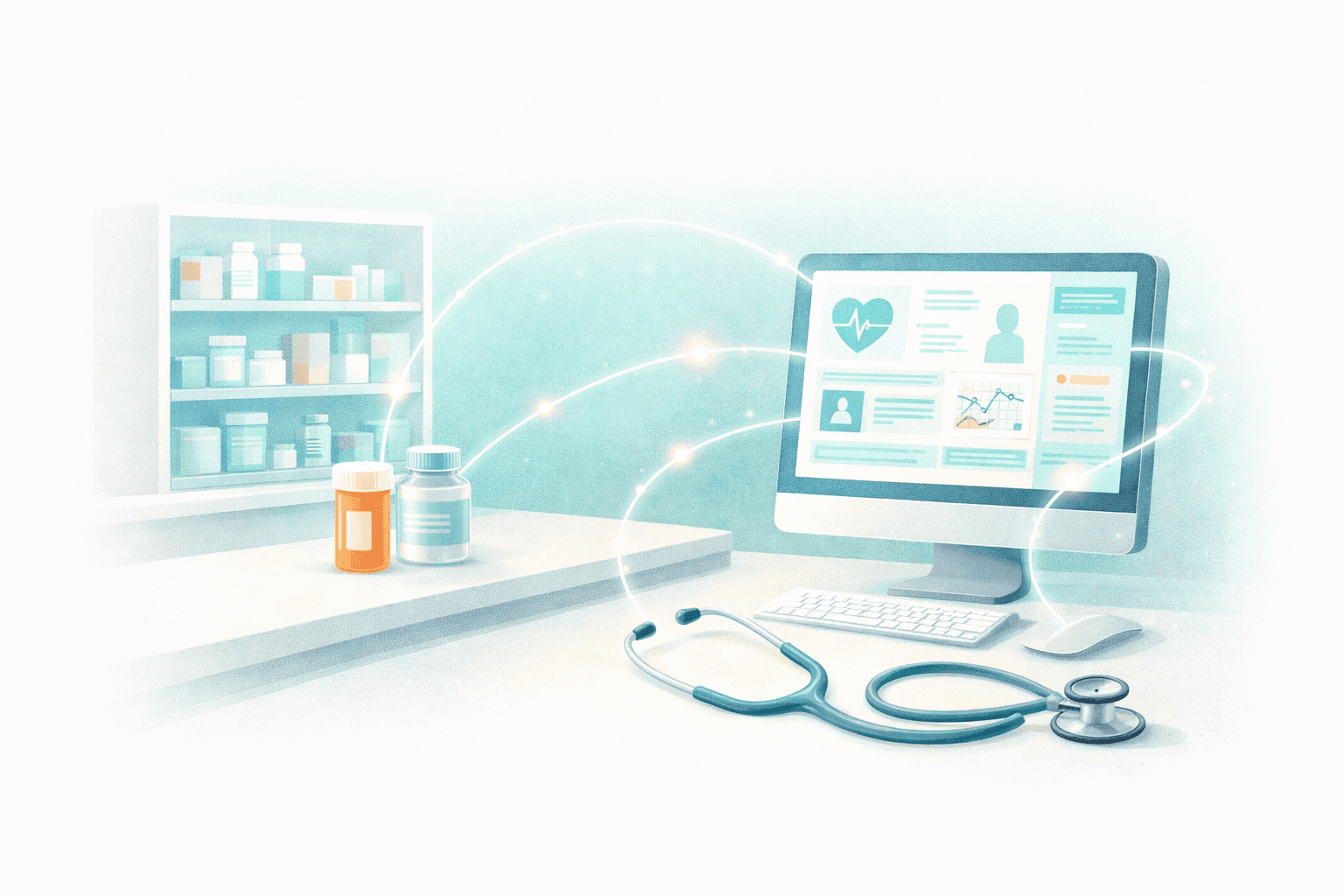
If you work in healthcare, you are already using AI — even if nobody told you. It is embedded in your electronic health record system, your pharmacy dispensing software, your billing platform, and your scheduling tools. Understanding what it is doing helps you use it better and catch it when it makes mistakes.
AI in the Pharmacy
Modern pharmacy systems use AI for three critical functions:
- Drug interaction checking: AI-powered systems cross-reference new prescriptions against a patient's complete medication list, allergies, lab values, and diagnoses. Advanced systems can identify interactions that traditional rule-based checkers miss — including interactions that only become significant in the presence of a third medication or a specific lab value.
- Inventory forecasting: AI predicts which medications will be needed based on seasonal patterns, local disease trends, and prescription history. This reduces both stockouts and waste.
- Adherence support: Predictive models identify patients at risk of not following their medication regimen based on refill patterns, complexity of their drug regimen, and demographic factors. This allows targeted outreach before problems develop.
Studies show AI-assisted dispensing systems have reduced medication errors by up to 75 percent in facilities that implement them fully.
AI in Coding and Billing
- Code suggestions: AI reads clinical documentation and suggests appropriate diagnosis and procedure codes, improving accuracy by 12 to 18 percent compared to manual coding alone.
- Documentation improvement: AI identifies gaps in clinical documentation that could lead to downcoding or claim denials, prompting providers to add relevant details before submission.
- Denial prediction: Machine learning models analyze historical claims data to flag submissions likely to be denied, allowing corrections before the claim is sent.
AI in Clinical Workflows
- Vital sign analysis: AI monitors continuous vital sign data to detect early warning signs of deterioration — identifying patterns that precede sepsis, cardiac events, or respiratory failure hours before they become clinically obvious. One system demonstrated 82 percent accuracy in predicting sepsis onset up to six hours in advance.
- Documentation support: Ambient listening tools convert provider-patient conversations into structured clinical notes, reducing documentation time by 30 to 50 percent.
- Clinical decision support: AI systems provide evidence-based recommendations during care delivery, such as suggesting relevant screening tests or highlighting contraindications.
AI in Administrative Operations
- Scheduling optimization: AI predicts no-shows and cancellations, suggesting overbooking levels that maximize capacity without creating excessive wait times.
- Patient communication: AI-powered systems handle appointment reminders, pre-visit instructions, and routine follow-up messages, personalizing timing and channel based on patient preferences.
- Workflow coordination: AI helps manage patient flow through departments, predicting bottlenecks and suggesting resource adjustments in real time.
The Human Oversight Imperative
Every one of these applications has the same critical requirement: human oversight. AI suggests — humans verify and decide. An AI drug interaction alert still requires a pharmacist's clinical judgment to determine whether the interaction is clinically significant for this specific patient. An AI-suggested diagnosis code still requires a coder's review to ensure accuracy.
The reason AI works well in healthcare is not that it replaces human judgment — it is that it handles the volume and speed that humans cannot match, while humans provide the contextual understanding, empathy, and accountability that AI cannot provide.
If you work in healthcare, your job is not threatened by AI. It is being augmented by it. Understanding what the AI in your tools is doing — and where it needs your oversight — makes you better at your job and safer for your patients.