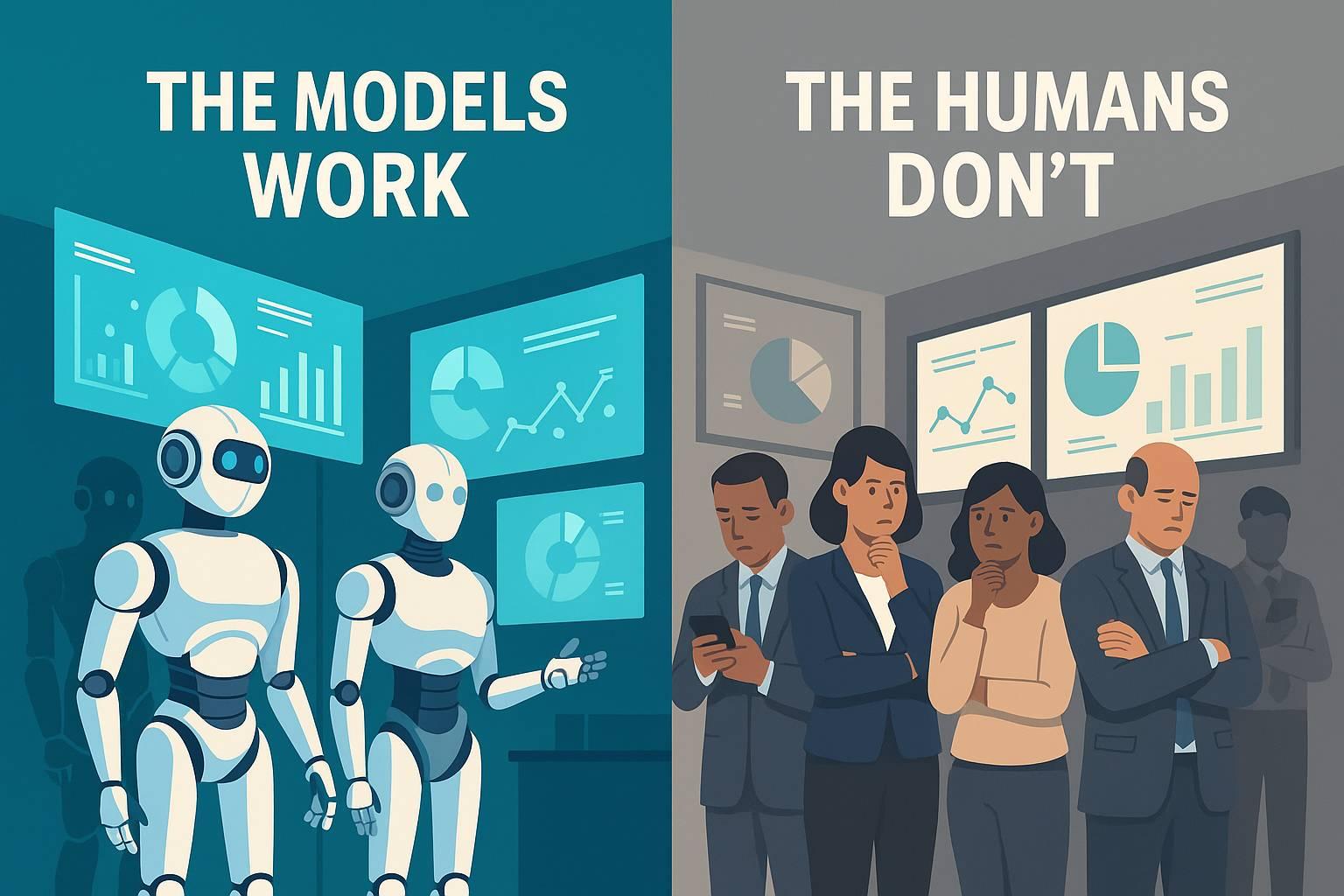
'Will AI take my job?' is the wrong question. The better question is: 'How will AI change what my job looks like in two years?' The answer, for most people, is not replacement — it is transformation.
Jobs Transform More Than They Disappear
History offers a useful pattern. When ATMs were introduced, people predicted the end of bank tellers. What actually happened was that the cost of running a bank branch dropped, so banks opened more branches and hired more tellers — but the job shifted from counting cash to selling financial products and advising customers.
AI is following a similar pattern. Routine tasks within jobs are being automated, but the jobs themselves are evolving rather than vanishing. A marketing manager who used to spend four hours writing first drafts now spends one hour refining AI-generated drafts and three hours on strategy and creative direction. The job did not disappear — the time allocation shifted.
Six Skills AI Cannot Replace
Certain human capabilities become more valuable as AI handles more of the routine work:
- Critical judgment: The ability to evaluate information, weigh trade-offs, and make decisions when the answer is not clear-cut. AI can present options; humans must choose among them.
- Ethical reasoning: Navigating right and wrong, fairness and harm, in situations that do not have algorithmic solutions.
- Contextual understanding: Knowing the unwritten rules, the political dynamics, the historical context that shapes how work actually gets done in your specific environment.
- Empathy: Genuinely understanding what another person is feeling and responding in a way that acknowledges their experience. AI can simulate empathy; it cannot feel it.
- Creative problem-solving: Connecting ideas from different domains in unexpected ways to solve problems that have not been solved before.
- Relationship-building: Trust, rapport, and genuine human connection remain irreplaceable in business, healthcare, education, and every other field.
The Complementary Approach
The highest-performing teams are not choosing between AI and human effort. They are combining them. AI handles the volume, speed, and consistency. Humans handle the judgment, creativity, and relationship work. Together, the combination outperforms either alone.
A radiologist using AI-assisted image analysis catches more anomalies than either the radiologist or the AI would alone. A customer service team using AI for initial response triage provides faster, more accurate service than either could independently. The pattern repeats across industries.
A Three-Month Learning Framework
You do not need to become a data scientist. You need to stay current enough to use AI tools effectively and make informed decisions about them. Here is a manageable approach:
Month 1: Apply
Pick one AI tool relevant to your work and use it daily for 30 days. Learn its strengths, its limitations, and its quirks through actual use. Read the documentation. Watch a few tutorials. But mostly, just use it.
Month 2: Expand
Try a second tool or a different use case for the first tool. Compare approaches. Talk to colleagues about how they are using AI. Read two or three articles about AI developments in your specific industry.
Month 3: Share
Teach someone else what you have learned. Create a short guide, give a five-minute presentation, or simply mentor a colleague. Teaching forces you to organize your knowledge and reveals gaps in your understanding.
Then repeat. Adaptability is a habit, not a single decision. The people who thrive alongside AI will not be the ones who learned the most in one burst — they will be the ones who never stopped learning.