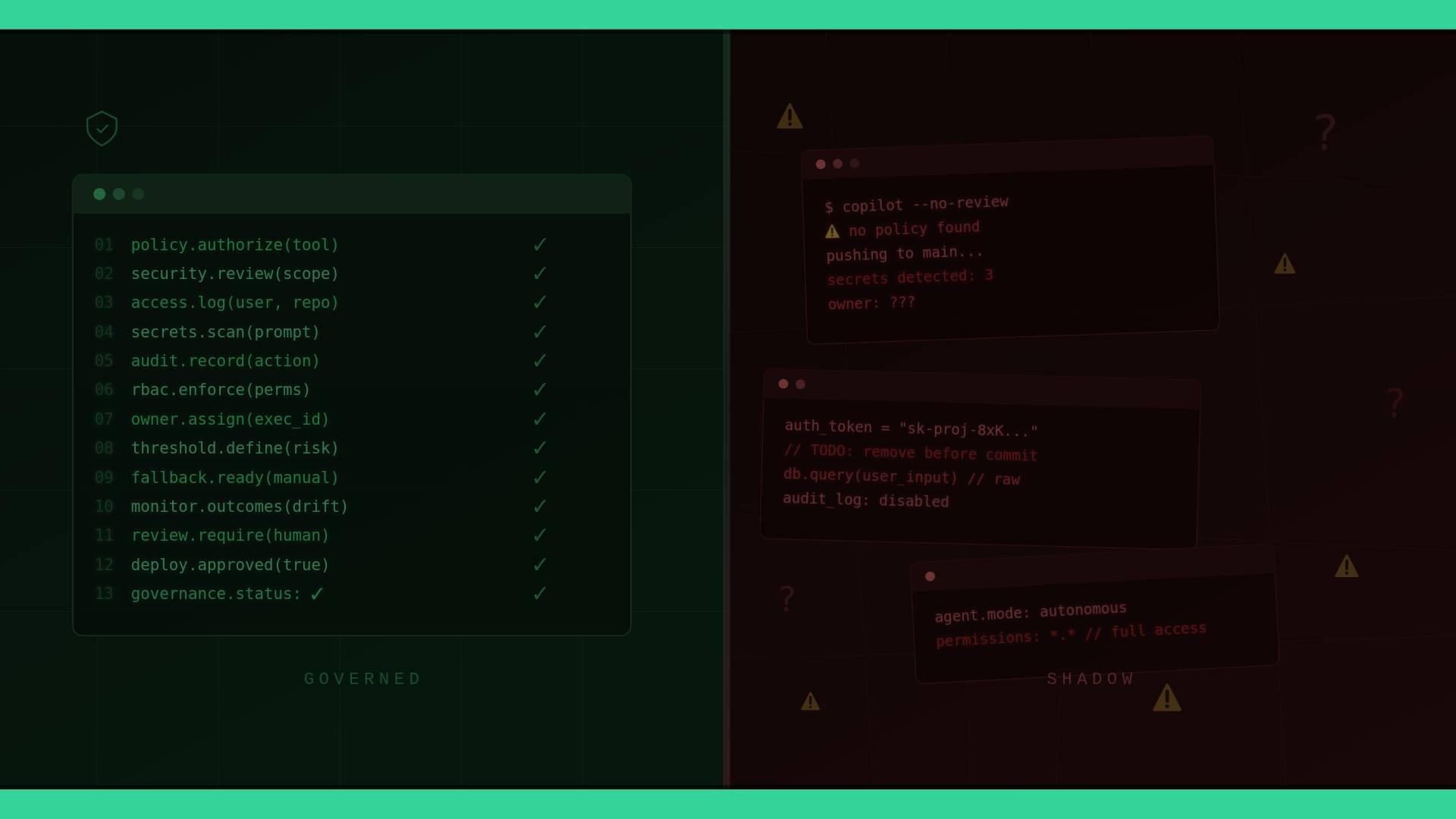
Every organization using AI today is making a bet — that the systems they deploy will behave as intended, treat people fairly, and not land them on the front page for the wrong reasons. AI governance is how you stack that bet in your favor.
Unlike traditional software that follows deterministic rules, AI systems learn from data, operate with varying degrees of opacity, and can produce unexpected outputs at scale. These characteristics don't make AI dangerous by default, but they do make it ungovernable by traditional IT oversight alone.
This article breaks down what AI governance actually means in practice, why it's different from anything your organization has managed before, and how to start building a governance program that enables innovation rather than blocking it.
AI Is Not Just Another Technology
Does your AI system's data handling meet regulatory expectations? AI systems are fundamentally different from traditional software — they are probabilistic, opaque, autonomous, and data-dependent. In practice, organizations that implement this systematically report fewer incidents, faster regulatory response times, and higher stakeholder confidence in their AI deployments.
A common misconception is that this only applies to large enterprises, but in reality generally accepted definitions from oecd and the eu ai act frame ai as a socio-technical system, not just code. Implementation requires clear ownership, defined timelines, and measurable success criteria. Governance activities without accountability tend to atrophy as competing priorities consume attention. Start with a pilot, measure results, and iterate. Governance practices that emerge from practical experience are more durable than those designed in a vacuum.
The unique characteristics that set AI apart: complexity, opacity, speed and scale, potential for harm, data dependency. Leading organizations have found that addressing this systematically — rather than on a case-by-case basis — produces better outcomes and reduces the total cost of governance over time. The practical implication is that risk assessment must be continuous, not a one-time pre-deployment exercise. Risks evolve as the system operates, as the data changes, and as the regulatory environment shifts.
The Business Case for AI Governance
From an operational standpoint, the key challenge is risk management: ai failures carry reputational, legal, and financial consequences. Implementation requires clear ownership, defined timelines, and measurable success criteria. Governance activities without accountability tend to atrophy as competing priorities consume attention. Start with a pilot, measure results, and iterate. Governance practices that emerge from practical experience are more durable than those designed in a vacuum.
Regulatory compliance: the EU AI Act, NIST AI RMF, and ISO 42001 are creating enforceable standards. The EU AI Act codifies this requirement in law, with specific articles addressing provider and deployer obligations. Organizations subject to the Act must document their compliance approach and maintain evidence for regulatory inspection. For organizations just starting their governance journey, the key is to begin with the highest-risk AI systems and build governance practices incrementally rather than attempting to govern everything at once.
The status quo — governing AI with existing IT frameworks — is no longer sufficient. competitive advantage: governance-ready organizations deploy ai faster with fewer incidents. If you're starting from scratch, focus on the highest-risk AI systems first. Document what you have, assign ownership, and build governance practices one layer at a time. Perfect governance on day one isn't the goal — measurable progress is.
Core Principles of Responsible AI
Fairness, safety/reliability, privacy/security, transparency/explainability, accountability, human-centricity. Research and enforcement actions have repeatedly demonstrated that algorithmic bias causes measurable harm. The EEOC, FTC, and CFPB have all signaled that existing non-discrimination laws apply fully to AI-driven decisions. For organizations just starting their governance journey, the key is to begin with the highest-risk AI systems and build governance practices incrementally rather than attempting to govern everything at once.
The status quo — governing AI with existing IT frameworks — is no longer sufficient. these principles appear across oecd, eu, nist, and every major framework — the consensus is clear. If you're starting from scratch, focus on the highest-risk AI systems first. Document what you have, assign ownership, and build governance practices one layer at a time. Perfect governance on day one isn't the goal — measurable progress is.
What would happen if this governance control failed? Why traditional IT governance is insufficient — AI needs domain-specific policies and controls. In practice, organizations that implement this systematically report fewer incidents, faster regulatory response times, and higher stakeholder confidence in their AI deployments.
Getting Started
The status quo — governing AI with existing IT frameworks — is no longer sufficient. start with inventory: what ai systems are in use today?. If you're starting from scratch, focus on the highest-risk AI systems first. Document what you have, assign ownership, and build governance practices one layer at a time. Perfect governance on day one isn't the goal — measurable progress is.
What would happen if this governance control failed? Assign ownership: governance needs a named accountable owner. In practice, organizations that implement this systematically report fewer incidents, faster regulatory response times, and higher stakeholder confidence in their AI deployments.
From an operational standpoint, the key challenge is build cross-functional: ai governance cannot live in one department. Implementation requires clear ownership, defined timelines, and measurable success criteria. Governance activities without accountability tend to atrophy as competing priorities consume attention. Start with a pilot, measure results, and iterate. Governance practices that emerge from practical experience are more durable than those designed in a vacuum.
What to Do Next
- Assess your organization's current practices against the key areas covered in this article and identify the top three gaps
- Assign clear ownership for each governance activity discussed — accountability without a named owner is just aspiration
- Establish a regular review cadence (quarterly at minimum) to evaluate whether governance practices are keeping pace with AI deployment
This article is part of AI Guru's AI Governance series. For more practitioner-focused guidance on AI governance, risk management, and compliance, explore goaiguru.com/insights.