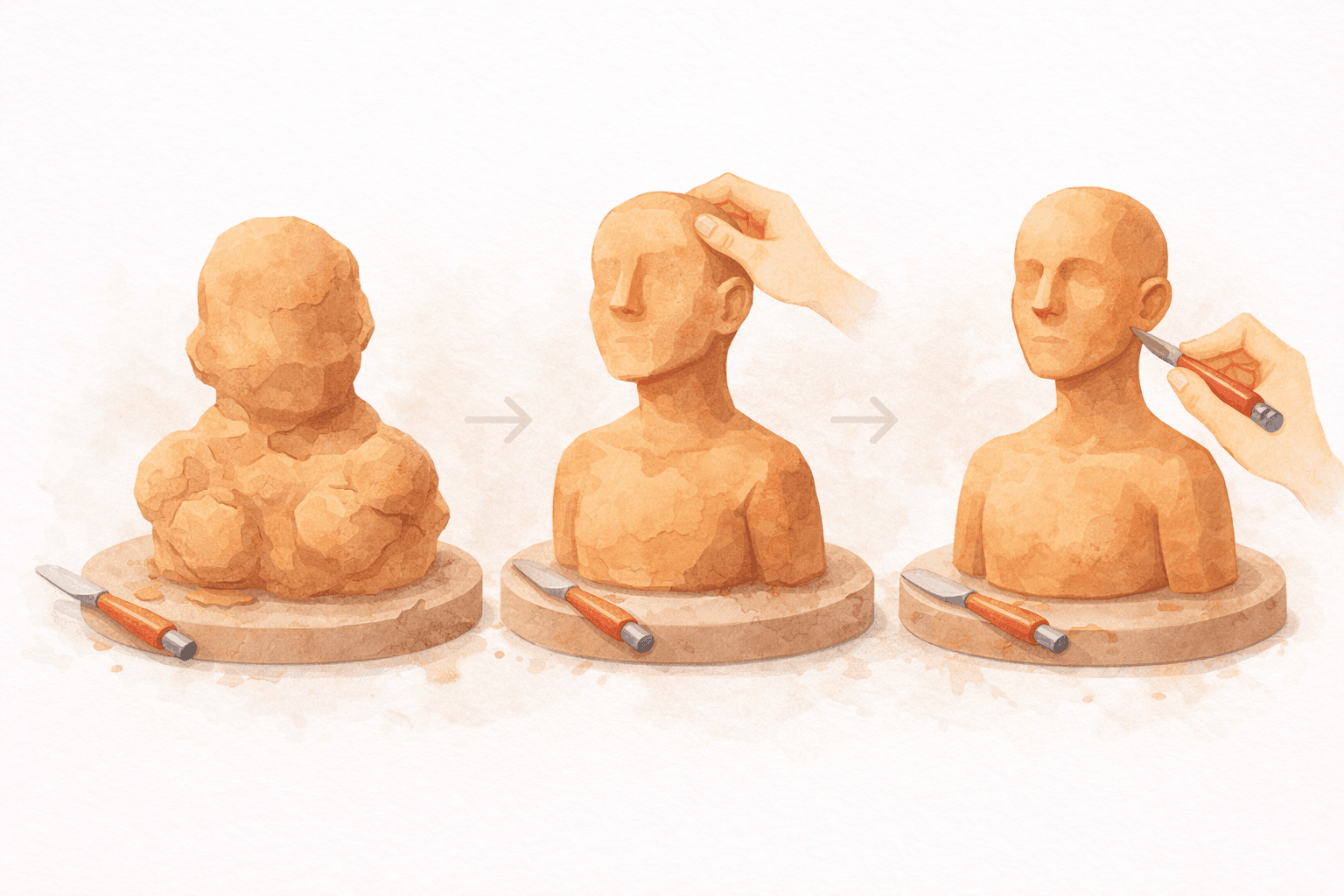
Here is something experienced AI users know that beginners do not: the first response is almost never the final answer. It is a starting point — a rough draft you shape through conversation. The real skill is not writing a perfect first prompt. It is knowing how to refine what comes back.
Think of it like working with a talented but literal-minded assistant. The first draft gets you in the right neighborhood. The follow-up instructions get you to the right address.
Diagnose the Gap First
Before you refine, identify what is actually wrong. The response usually fails in one of five ways:
- Wrong tone: Too formal, too casual, too technical, too simple.
- Wrong length: Too long, too short, too detailed, not detailed enough.
- Wrong focus: Addresses a related topic but not exactly what you asked.
- Wrong format: Prose when you needed bullets. A wall of text when you needed sections.
- Wrong detail level: Surface-level overview when you needed depth, or overwhelmingly detailed when you needed a summary.
Once you know which category the problem falls into, your follow-up prompt can target exactly that — instead of starting over from scratch.
Technique 1: Role Assignment
Tell the AI who to be. The same topic, explained by different roles, produces dramatically different output.
Try: 'Explain this as if you are a patient and experienced manager talking to a new employee during their first week.' Or: 'Rewrite this from the perspective of a financial auditor reviewing the proposal.' Or: 'Explain this the way a doctor would explain it to a patient — clear, direct, no jargon.'
Role assignment changes vocabulary, emphasis, detail level, and assumptions all at once. It is the fastest single-prompt technique for redirecting output.
Technique 2: Structured Output Requests
If the first response was unstructured, tell the AI exactly how to organize the next version. Be prescriptive:
'Reorganize this into four sections: Problem, Current Approach, Proposed Solution, and Next Steps. Each section should be 2-3 sentences. Use bold section headers.'
Structure requests work well because AI is excellent at reformatting. You are leveraging one of its strongest capabilities.
Technique 3: Show, Don't Tell
Instead of describing what you want, give an example. Paste a paragraph you have already written and say: 'Match this tone and style for the rest of the document.' Or provide a template: 'Use this format for each item: [Name] — [One-sentence description] — [Key benefit].'
Examples eliminate ambiguity. The AI stops guessing what you mean and starts matching what you showed.
When to Refine vs. When to Start Over
Refine when the AI got the general direction right but the execution needs adjustment — wrong tone, wrong length, wrong structure. These are surface problems.
Start over when the AI fundamentally misunderstood what you were asking for. If the entire response is about the wrong topic or takes a completely wrong angle, a follow-up prompt will just polish the wrong answer. Rewrite your initial prompt with more context and try again.
How Many Rounds Is Normal?
Two to three rounds of refinement is typical for a good result. If you are on round five or six and still not getting what you need, step back. Either your initial prompt needs rethinking, the task may not be well-suited to AI, or you need to break it into smaller pieces.
The goal is not perfection from the AI. The goal is a strong starting point that you can finalize with your own judgment and expertise. That is where efficiency lives.